

How To Remove An Axle Nut
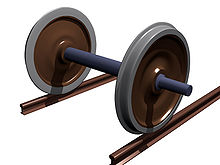
Railroad car wheels are affixed to a straight axle, assuasive both wheels to rotate at the aforementioned time. This is chosen a wheelset.
An axle or axletree is a central shaft for a rotating wheel or gear. On wheeled vehicles, the axle may be stock-still to the wheels, rotating with them, or fixed to the vehicle, with the wheels rotating effectually the axle.[ane] In the former example, bearings or bushings are provided at the mounting points where the beam is supported. In the latter case, a bearing or bushing sits inside a central hole in the wheel to let the cycle or gear to rotate around the beam. Sometimes, especially on bicycles, the latter type axle is referred to as a spindle.
Terminology [edit]
On cars and trucks, several senses of the discussion axle occur in casual usage, referring to the shaft itself, its housing, or just whatsoever transverse pair of wheels. Strictly speaking, a shaft which rotates with the wheel, existence either bolted or splined in fixed relation to it, is called an axle or axle shaft. However, in looser usage, an entire assembly including the surrounding axle housing (typically a casting) is also called an axle.
An even broader (somewhat figurative) sense of the discussion refers to every pair of parallel wheels on contrary sides of a vehicle, regardless of their mechanical connexion to each other and to the vehicle frame or torso. Thus, transverse pairs of wheels in an independent suspension may be chosen an beam in some contexts. This very loose definition of "axle" is often used in assessing toll roads or vehicle taxes, and is taken as a crude proxy for the overall weight-bearing capacity of a vehicle, and its potential for causing wear or impairment to roadway surfaces.
Vehicle axles [edit]
Axles are an integral component of most applied wheeled vehicles. In a live-axle suspension organisation, the axles serve to transmit driving torque to the wheel, as well as to maintain the position of the wheels relative to each other and to the vehicle body. The axles in this system must also deport the weight of the vehicle plus whatsoever cargo. A non-driving axle, such as the front end beam axle in heavy duty trucks and some two-bike drive light trucks and vans, will have no shaft, and serves only as a suspension and steering component. Conversely, many front-wheel drive cars accept a solid rear beam axle.
In other types of interruption systems, the axles serve but to transmit driving torque to the wheels; the position and bending of the wheel hubs is an independent role of the pause organisation. This is typical of the contained suspensions found on most newer cars and SUVs, and on the front end of many light trucks. These systems still have differentials, just will not accept attached axle housing tubes. They may be attached to the vehicle frame or trunk, or integral in a transaxle. The axle shafts (usually abiding-velocity type) and then transmit driving torque to the wheels. Like a full floating axle system, the drive shafts in a front end-wheel bulldoze independent break arrangement exercise non support any vehicle weight
Structural features and design [edit]

A straight axle is a single rigid shaft connecting a wheel on the left side of the vehicle to a wheel on the right side. The axis of rotation fixed past the axle is mutual to both wheels. Such a design can keep the bike positions steady under heavy stress, and can therefore support heavy loads. Directly axles are used on trains (that is, locomotives and railway wagons), for the rear axles of commercial trucks, and on heavy duty off-road vehicles. The axle can optionally be protected and further reinforced by enclosing the length of the axle in a housing.
In split-axle designs, the wheel on each side is attached to a separate shaft. Modern passenger cars have dissever drive axles. In some designs, this allows contained suspension of the left and right wheels, and therefore a smoother ride. Even when the suspension is not independent, split axles allow the use of a differential, allowing the left and right drive wheels to be driven at different speeds equally the automobile turns, improving traction and extending tire life.
A tandem axle is a group of two or more axles situated close together. Truck designs utilise such a configuration to provide a greater weight capacity than a single axle. Semi trailers commonly have a tandem beam at the rear.
Axles are typically made from SAE form 41xx steel or SAE grade 10xx steel. SAE grade 41xx steel is unremarkably known as "chrome-molybdenum steel" (or "chrome-moly") while SAE grade 10xx steel is known every bit "carbon steel". The principal differences between the ii are that chrome-moly steel is significantly more resistant to angle or breaking, and is very difficult to weld with tools ordinarily plant outside a professional welding shop.[ii]
Drive axle [edit]

Splines on a forepart drive axle.
An axle that is driven by the engine or prime mover is called a bulldoze beam.
Modern front-wheel bulldoze cars typically combine the transmission (gearbox and differential) and front end axle into a single unit called a transaxle. The drive axle is a dissever beam with a differential and universal joints between the two one-half axles. Each one-half axle connects to the bike past use of a constant velocity (CV) articulation which allows the cycle associates to move freely vertically besides as to pivot when making turns.
In rear-wheel drive cars and trucks, the engine turns a driveshaft (also called a propellor shaft or tailshaft) which transmits rotational strength to a drive axle at the rear of the vehicle. The drive axle may be a alive axle, merely modern rear wheel bulldoze automobiles generally utilise a split axle with a differential. In this case, 1 half-beam or one-half-shaft connects the differential with the left rear bicycle, a 2nd one-half-shaft does the same with the right rear wheel; thus the two half-axles and the differential found the rear axle.[3] The forepart drive axle is providing the forcefulness to bulldoze the truck. In fact, only 1 wheel of that axle is actually moving the truck and trailer down the road.
Some simple vehicle designs, such equally leisure become-karts, may have a single driven bicycle where the drive axle is a split axle with simply one of the two shafts driven by the engine, or else have both wheels connected to one shaft without a differential (kart racing). Notwithstanding, other get-karts have two rear drive wheels too.
Elevator beam [edit]

Dump truck with an airlift pusher beam, shown in the raised position
Some dump trucks and trailers may be configured with a lift axle (too known as an airlift axle or drop axle), which may be mechanically raised or lowered. The axle is lowered to increase the weight capacity, or to distribute the weight of the cargo over more than wheels, for example to cross a weight restricted bridge. When non needed, the axle is lifted off the ground to save wear on the tires and beam, and to increase traction in the remaining wheels. Lifting an axle also alleviates lateral scrubbing of the additional axle in very tight turns, allowing the vehicle to plow more readily. In some situations removal of pressure level from the additional axle is necessary for the vehicle to complete a turn at all.[4]
Several manufacturers offer computer-controlled airlift, so that the expressionless axles are automatically lowered when the master beam reaches its weight limit. The dead axles can yet exist lifted past the printing of a button if needed, for improve maneuverability.
Elevator axles were in apply in the early 1940s. Initially, the axle was lifted by a mechanical device. Shortly hydraulics replaced the mechanical elevator system. One of the early on manufacturers was Zetterbergs, located in Östervåla, Sweden. Their brand was Zeta-lyften.
The liftable tandem drive axle was invented in 1957 by the Finnish truck manufacturer Vanajan Autotehdas, a company sharing history with Sisu Auto.
Total-floating vs semi-floating [edit]
A total-floating axle carries the vehicle'south weight on the axle casing, non the halfshafts; they serve only to transmit torque from the differential to the wheels. They "bladder" inside an assembly that carries the vehicle'south weight. Thus the merely stress it must endure is torque (not lateral bending force). Full-floating axle shafts are retained past a flange bolted to the hub, while the hub and bearings are retained on the spindle by a large nut. In contrast, a semi-floating design carries the weight of the vehicle on the axle shaft itself; there is a single bearing at the finish of the axle housing that carries the load from the axle and that the axle rotates through. To exist "semi-floating" the axle shafts must be able to "float" in the housing, bearings and seals and not field of study to axial "thrust" and/or bearing preload. Needle bearings and separate lip seals are used in semi-floating axles with axle retained in the housing at their inner ends typically with "c-clips" which are three/4-circular hardened washers that slide into grooves machined at the inner cease of the shafts and retained in/by recesses in the differential carrier side gears which are themselves retained by the differential pinion gear or "spider gear" shaft. A true semi-floating axle associates places no side loads on the axle housing tubes or beam shafts.
Axles which are pressed into ball or tapered roller bearings which are in turn retained in/on the axle housings with flanges, bolts and basics do not "bladder" and identify axial loads on the bearings, housings and only a short section of the shaft itself that as well carries all radial loads.
The total-floating design is typically used in most 3/four- and 1-ton lite trucks, medium duty trucks and heavy-duty trucks. There are a few exceptions, such as many Land-Rover vehicles and in American stock car racing since the early 1960s. The overall assembly can deport more weight than a semi-floating or non-floating beam associates, because the hubs accept two bearings riding on a fixed spindle. A full-floating axle tin can be identified by a protruding hub to which the axle shaft flange is bolted.
The semi-floating axle setup is normally used on half-ton and lighter 4x4 trucks in the rear. This setup allows the axle shaft to be the means of propulsion, and likewise support the weight of the vehicle. The primary difference between the full- and semi-floating axle setups is the number of bearings. The semi-floating axle features only ane bearing, while the total-floating assembly has bearings in both the inside and outside of the bike hub. The other difference is virtually the axle removal. To remove the semi-floating axle, i has to remove a bicycle beginning; if such axle breaks, the bike is about likely to come off the vehicle. The semi-floating design is establish nether well-nigh 1/2-ton and lighter trucks and SUVs and rear-wheel-bulldoze passenger cars, ordinarily being smaller or less expensive models.
A benefit of a full-floating beam is that even if an axle shaft (used to transmit torque or ability) breaks, the wheel will not come off, preventing serious accidents.
Run into also [edit]
- All pages with titles beginning with Axle
- All pages with titles containing Axle
- Beam axle
- Gölsdorf axle
- Klien-Lindner axle
- Luttermöller axle
- Portal axle
- Powertrain
- Transaxle
- Wagon bike (transportation)
- Bicycle and axle
- Wheelset (rail transport)
References [edit]
- ^ Mechanical Engineering blueprint (9th ed.). McGraw Colina. 2010. p. 360. ISBN978-0073529288.
- ^ "Ring & Pinion". Archived from the original on four November 2022. Retrieved ix October 2022.
- ^ "Drive Beam Repair & Axle Replacement Service – Axle Dr.".
- ^ "using a lift axle". Truck driver. The Trucker'south Written report. Retrieved 28 Dec 2022.
External links [edit]
- Truck Beam Blueprint Archived 7 March 2022 at the Wayback Machine
Source: https://en.wikipedia.org/wiki/Axle
0 Response to "How To Remove An Axle Nut"
Post a Comment